

Various Passages
Below is a sermon manuscript from October 26, 2025. Watch the sermon here.
Introduction
Early church thinker, Tertullian, famously said, “What indeed does Athens have to do with Jerusalem?” By this, he meant what Greek philosophy has to do with the Christian faith. Maybe your thought as we deal with the topic of citizen is “What does Capitol Hill have to do with Jerusalem?” Hopefully, by now, you have seen that all of our life matters to God and can be used for him. Still, this area seems particularly fraught with difficulty. We might desire to stick with Tertullian’s motto when it comes to this particular area. This might be what H. Richard Neihbur described as Christ against culture.
But even this is a way to approach culture. We are not entirely removed. We also need to understand how our call as citizens varies from those who have come before us. In many ways, our calling as citizens is our calling to follow Jesus in this particular calling, just like in our other callings.
Our statement of faith, Article 8, says this,
We believe that God’s justifying grace must not be separated from His sanctifying power and purpose. God commands us to love Him supremely and others sacrificially, and to live out our faith with care for one another, compassion toward the poor and justice for the oppressed. With God’s Word, the Spirit’s power, and fervent prayer in Christ’s name, we are to combat the spiritual forces of evil. In obedience to Christ’s commission, we are to make disciples among all people, always bearing witness to the gospel in word and deed.
In 2023, the EFCA’s leadership released several affirmations and denials regarding current trends. I think this is helpful because it defines terms while critiquing. Too often today terms are thrown out and used as ammunition. But we always must ask, “What do you mean by that?”
- We are not “Christian Nationalists” who believe the federal government should declare the United States a Christian nation or who believe that Americans are “God’s chosen people,” but we do believe that a patriotic love of one’s nation is appropriate and that Christians should be good citizens who may freely advocate for God-honoring public policies.
- We do not believe that political means can establish the kingdom of God, but we do believe that God has appointed governing authorities to do good and that, for citizens in Christ’s kingdom, King Jesus’ rule and reign transcends all other citizenships and partisan ideologies and transforms how we live in the world.
As a Citizen, Glorify God
Just as we mentioned the importance of character, conviction, and competence in the workplace these also play a role in our calling as citizen.
Our primary calling influences our secondary callings
Philippians 3:20-21 says,
“But our citizenship is in heaven, and from it we await a Savior, the Lord Jesus Christ, who will transform our lowly body to be like his glorious body, by the power that enables him even to subject all things to himself.”
There is alot in these verses. First we see that our citizenship is in heaven. Some overplay this idea as if it completely removes earthly responsibility. That is not what Paul is getting at. Instead, he is reminded his readers that they belong to a greater kingdom. The context is a call for them to persevere and not get pulled down by the temptations around them. We will talk about this in a bit. For now, it is important to reflect that we have primary citizenship in heaven and that this citizenship involves both waiting for ultimate completion as we serve one who is Lord over all.
One of the ways we serve him is by seeking the good of where he has placed us. We might think of Jeremiah 29:7, where the exiled people of God in the Old Testament are taught to seek the welfare of the city and to pray to God on its behalf. This language is picked up by Peter who speaks of the church as exiles in 1 Peter 2.
Politics can corrupt our character, but we are called to glorify God in our conduct
42% of people view the opposite political party as downright evil. [1] This is stirred up not only by those who hold office, but even recently, I have seen Christian thinkers on both sides of the political spectrum who have labeled the other side evil.
Especially in a digital age, we are tempted to reduce others to avatars. We assign certain characteristics to those on the other side of the aisle and then dismiss them. This directly contradicts Christian teaching. We learn in Scripture that every person is made in the image of God and is worthy of value, dignity, and respect. The Bible also teaches that all have sinned. While our sin separates us from God relationally, it does not take away from our created worth. Further, Scripture shows that God provides the righteous and the unrighteous with common blessings. This means not only that we are called to value all people, but also that we can learn from one another.
In Matthew 5:44, we are called to “But I say to you, love your enemies and pray for those who persecute you.”
I want us to think about this in terms of the various callings we have already discussed. Sometimes political differences can divide families. But this happens by letting politics or our call as citizens be the primary call. It is, then, in the driver’s seat for how we live our call to our family. A political tribe determines how we treat our family instead of God’s Word. Here’s the problem. The tribe didn’t die for its enemies. The tribe didn’t conquer death, so we might live. The tribe didn’t send the Holy Spirit to guide and direct us. Politics can be a good avenue to bless others as a secondary calling. But when it’s ultimate, the opposite happens; it becomes the justification by which to curse others. God becomes a pawn to baptize our vicious behavior instead of the authority regulating it.
Politics can corrupt our convictions, but we are called to glorify God in our beliefs
As mentioned before, our convictions are formed by the Word of God. Remember that Paul said that without the law, he wouldn’t have known what sin was. This understanding of God’s law and how it reveals sin to us is helpful. Earthly laws can also function this way, as they align with what is true. Martin Luther King Jr said this in his letter from Birmingham jail,
A just law is a man-made code that squares with the moral law, or the law of God. An unjust law is a code that is out of harmony with the moral law. To put it in the terms of St. Thomas Aquinas, an unjust law is a human law that is not rooted in eternal and natural law.[2]
One of the losses in contemporary discourse is the fading of natural law or common good reasoning. When justice is reduced to sentiment, identity, or power, it loses the moral grammar that made the Civil Rights Movement so compelling. We should be reminded that the Christian ethic never pits love and truth against one another. 1 Corinthians 13 tells us,
Love is patient and kind; love does not envy or boast; it is not arrogant or rude. It does not insist on its own way; it is not irritable or resentful; it does not rejoice at wrongdoing, but rejoices with the truth. Love bears all things, believes all things, hopes all things, endures all things.[3]
This relates to how Christians enter into our call as citizens through the lens of our primary call to Christ. Some do this via what has been called the third way or post-partisan approach. There are faithful Christians who pursue this method, but I fear that it can lack a proper foundation. It’s true that not every person who adopts this view lacks a foundation, but many do. Patrick Schreiner, a New Testament scholar, recently put up a healthy vs. unhealthy approach to this.
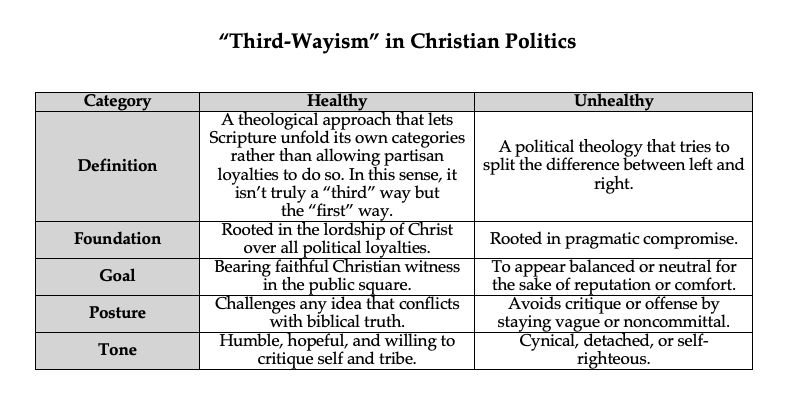
But this does little to provide a solid foundation. It is more descriptive of motivations, which we can’t really judge, than how things go wrong and can slip into an unhealthy approach. I think it is better to ground our approach in a robust political theology. Again, some may still call this the third way, but I think framing it as political theology can help us avoid the starting point of partisanship. A theology of politics examines what all of Scripture teaches regarding ethics and our responsibilities, synthesizes it, and offers a framework from which to engage. We still should evaluate these according to Scripture, but instead of starting from scratch, it can be helpful to adopt one and then seek to evaluate it and continually assess – see this chart in contrast to Christian Nationalism and an ungrounded Third-Way.

Politics can be reactionary, but we must think deeply and act in accordance with our knowledge
One reason for the boiling aspect of politics is that many view it as the ultimate. If this life is all we have, politics gives a way to bring value and lasting impact. But politics makes a lousy god. It demands more and more and never delivers the results that we want. More than that, it necessarily pits us against one another. The Christian can enter into this territory with hope. Psalm 2 tells us that the king is seated on high above nations as they rage.
We engage with hope and act in accordance to our knowledge. As we have said already in this series, there is a distinction between a minimal faithfulness and a maximal fruitfulness. All are called to be faithful, but some have more time and gifting to press in and do more good with this call than others, and that is ok.
As a citizen, Love Your Neighbor
Matthew 22:37-40
37 And he said to him, “You shall love the Lord your God with all your heart and with all your soul and with all your mind. 38 This is the great and first commandment. 39 And a second is like it: You shall love your neighbor as yourself. 40 On these two commandments depend all the Law and the Prophets.”[4]
We are called to love our neighbor as ourselves. Again, even this command can be misconstrued today. Today, love is often reframed as affirmation or celebration. But this does not correspond to real life. The opposite of love is not correction but indifference. Romans 1:32 warns us against giving approval to sinful practices. To love our neighbor means ordering our public and private lives according to God’s justice and design. We must uphold the truth about marriage, life, and creation not only privately but for our neighbors’ good. It means caring for our neighbor’s welfare and ultimate good.
Local is often overlooked for the national spectacle
As we examine the life of Jesus, his day-to-day life seemed to be oriented around those with whom he came in contact. We also see this as an example of the life of Paul. 1 Thessalonians tells us that he made it his mission to give of his very self for those he was called to serve. As we said before, Peter picks up on the language of Jeremiah and says to keep their conduct honorable. In theology, there is something called the moral proximity principle. It describes the different obligations we have as outlined in Scripture to family, our local church, and those who are near us. This isn’t meant to remove our call to love everyone, but it serves to free us to love those we are in contact with. In a hyper-connected world, we can see more opportunities to help than we have the capacity to meet. But we can serve those who are in our sphere of influence.
We have people in our congregation who have served on school boards. Others who have helped those who have been impacted negatively in our politically charged world. We have members who have helped raise funds, volunteered, and served on the boards of Out of the Cold and Pregnancy Resource Clinic. This is time well spent for the good of our neighbors.
Different ways to be involved
Many distinguish between relief, development, and reform. Relief is temporary assistance for people who are in need. Development is another step that helps people get to a sustainable place or develop systems that help with this. Reform seeks to impact laws in order for flourishing to occur. These distinctions can be helpful as we apply how we can serve as individuals and how we are a local church that is involved. As a local church, we help as able by providing help through our benevolence team. We bring to attention local ministries for people to be involved in, but we don’t have a specific aspect of our ministry dedicated to development or to reform. Development requires significant resources, which is why we promote parachurch organizations that are involved, and reform often involves political decisions and can lead to being enmeshed too with civil authorities or political parties. Part of what it means to be a free church is being free from government control and not being a state-sponsored church. We want to maintain this heritage and our independence.
As a Citizen, Benefit Your Country
As we stated before, we must obey God rather than man. I believe there is a time and place for civil disobedience. But as we are able, it is good to promote the flourishing of the place that we inhabit.
Christians are called to pray for leaders
1 Peter 2:1-4
First of all, then, I urge that supplications, prayers, intercessions, and thanksgivings be made for all people, 2 for kings and all who are in high positions, that we may lead a peaceful and quiet life, godly and dignified in every way. 3 This is good, and it is pleasing in the sight of God our Savior, 4 who desires all people to be saved and to come to the knowledge of the truth[5]
The idea of praying for the good of leaders is not contingent on whether we voted for them or agree with their every decision. The prayer does not mean that we ask God to grant them success in contributing to anything that contradicts God’s Word or His good design for us. But it does mean that we pray for them, that God works through them to further His purposes.
This prayer also seems to imply that one of the reasons for prayer is for the ability for Christians to live faithfully in this life. Leaders benefit when Christians have the liberty to worship and live faithful lives before God.
An example of this is given in the early church, Tertullian wrote and told the Emperor that while they are falsely accusing the Christians, the Christians are praying for their good. He said, We don’t say this merely to flatter you, search our Scriptures and you will see that we are commanded to pray for you. Kill us if you must, but you are killing the ones in the empire that are praying to the true God on your behalf.
Christians are called to obedience whenever possible
Obedience is the general posture
Romans 13:1-7 and 1 Peter 2:13-17 both teach that Christians are to obey authorities.
Let every person be subject to the governing authorities. For there is no authority except from God, and those that exist have been instituted by God. 2 Therefore whoever resists the authorities resists what God has appointed, and those who resist will incur judgment. 3 For rulers are not a terror to good conduct, but to bad. Would you have no fear of the one who is in authority? Then do what is good, and you will receive his approval, 4 for he is God’s servant for your good. But if you do wrong, be afraid, for he does not bear the sword in vain. For he is the servant of God, an avenger who carries out God’s wrath on the wrongdoer. 5 Therefore one must be in subjection, not only to avoid God’s wrath but also for the sake of conscience. 6 For because of this you also pay taxes, for the authorities are ministers of God, attending to this very thing. 7 Pay to all what is owed to them: taxes to whom taxes are owed, revenue to whom revenue is owed, respect to whom respect is owed, honor to whom honor is owed.
13 Be subject for the Lord’s sake to every human institution, whether it be to the emperor as supreme, 14 or to governors as sent by him to punish those who do evil and to praise those who do good. 15 For this is the will of God, that by doing good you should put to silence the ignorance of foolish people. 16 Live as people who are free, not using your freedom as a cover-up for evil, but living as servants of God. 17 Honor everyone. Love the brotherhood. Fear God. Honor the emperor.[6]
Both texts show the God given authority of governing authorities. Their role is to restrain evil. The call of the state is different than the call of the church. The church is called to proclaim the gospel, not to use force but to persuade and pray. But the state carries out justice in order to maintain the other aspects of life. Some have referred to the state as the referee, ensuring that the other spheres of life function well.
Anthony Bradley says it like this,
Society is not a single entity to be managed by the state, nor is it merely a chaotic mass of individuals. It is a complex ecosystem of distinct, God-ordained spheres, including the family, the church, the academy, the market, and the arts. Each sphere possesses its own integrity and God-given authority. Parental authority is not granted by the state; it is inherent to the family. The church’s spiritual authority is not subject to political approval.
A Christian vision of politics, therefore, is one that respects and protects this created diversity. It resists the liberal tendency to dissolve all institutions into the acid bath of individual choice, and it rejects the socialist and nationalist temptation to subordinate all of society to the will of the state. It seeks a government that enables families, churches, schools, and businesses to fulfill their unique callings.
Civil disobedience may be permissible
Both Romans 13 and 1 Peter 2, even while commanding Christians to be subject and obey, do so while giving parameters for the authorities. 1 Peter mentions doing it for the Lord’s sake and that governors are to punish evil and praise good. While the default position for Christians is to persuade and influence toward a society where good can flourish and evil is restrained, there may be times when it is permissible to practice civil disobedience as prophetic witness. Differing approaches and likely personalities may be more prone to this than others.
Acts 5:29 But Peter and the apostles answered, “We must obey God rather than men.”
David Koyzis, in his book, Citizenship Without Illusions, gives six criteria for civil disobedience.
1. Avoid revolution where reform is possible.
2. Discerning whether to obey or disobey is best done in community.
Koyzis writes, “If you are the only one who thinks he or she is being oppressed, there is a good chance you are the one in the wrong. In our day, the notion of oppression is stretched rather thin, covering virtually anything that hinders the fulfillment of our desires.”[7]
3. Consider the appropriate means of civil disobedience.
Koyzis again, “You don’t cure a bunion by amputating the foot. Means must be suited to the ends. If we decide to disobey a law, we should do so in such a way as to minimize negative side effects for others, especially innocent persons.”[8]
4. If we decide to disobey a law for the sake of correcting injustice, we must be prepared to accept the consequences for doing so.
Christians engage provisionally as they aim for proxmimate justice
Can Christians benefit society as politicians?
I think there are many faithful Christians who are serving in the realm of politics. But it’s not easy. It reminds me in many ways of the calling of a pastor. Pastors inhibit a denominational stream they believe best understands the Biblical text. In a similar way, politicians enter into what they believe best understands the world we live in and our obligation toward others in the realm of politics.
Let’s keep this analogy, as broken as it may be, running. A pastor’s convictions can change, and they need to change denominations. They no longer believe that the denomination best represents the Bible’s teachings. Similarly, the denomination can drift or change views, and they are no longer able to serve in good conscience. There are those who are true Christians who are seeking to be faithful to Jesus, and they are serving in a denomination that I could not, in good conscience, even attend. For me, I could not do that, and it would be a sin. I don’t know their heart, and when there is not a direct violation of first-tier issues, I can still pray for them and hope for their best, even while trying to persuade in good Christian love.
As we said before, though, it’s not only the issues themselves, but there are also particular temptations that come with a calling. For many, politics would be corrupt. They would give in to spite and hate their enemies instead of loving them. They should avoid this. But others may be able to navigate this well, even as they, like each of us, fall prey to the temptations on occasion.
Benefit through your vote
Often, we go first to voting, but I have it as last for a reason. How should a Christian vote and approach partisan politics? This is a key and important question. But it is not the only question. As we described in the earlier session, we can be involved in a variety of ways. But we should think about the stewardship of the vote and using the power given to citizens. This looks different depending on the country a person lives in, but here, there is a level of authority given to each citizen, and we can participate through voting. What we have discussed to this point will factor into this decision. As we apply Biblical principles to a contemporary situation, we must understand both. There isn’t a one-to-one correlation, nor is there a specific verse that says “Christians must do X”; instead, we make decisions through theological and political reasoning. One thing we need to keep in mind is that we can’t compromise what we believe, but we can also acknowledge that politics, as an enterprise in a fallen world, often involves exercising prudential judgment and aiming for proximate justice. Bradley says it like this, “Which candidate or party will be most likely, in this specific moment, to do the least harm and contribute most to a just and pluriform society?”
Christians can then vote with a clear conscience. We also vote, acknowledging that this is not our only form of involvement. As we live faithfully in this world, we are a witness to our neighbors. As we love them through practical actions, we do our part. Since we have a higher allegiance, Christians can both vote for a party or candidate and critique and hold them accountable.
Conclusion
It is not cliché to say that we serve King Jesus above all. Psalm 72 gives us a glimpse of a Kingdom of peace that will never end. A kingdom that will stretch the globe. This is the hope we have as Christians. If you are here this morning and you are overwhelmed by the happenings in the world today, I want to give you a better way. There is a reason you long for justice and peace in this world. There is a reason that you feel their importance, but also are turned off by the methods that people use to try to get there. If this world is all there is, then it is very dark indeed. But what if the goodness and light are just as jarring? Why, if this world were merely a cosmic accident, is there a desire for something better? Why do we see glimpses of self-sacrifice? Why do things seem to go better when lived according to a book written thousands of years ago? Why does it align with certain intuitions that we already have? What if it’s because this book is true? What if it’s because a good God created this world to work in a certain way? What if it’s because not only did God create the world, but he loved it enough to send Jesus to come and redeem this world?
[1] Curtis Chang and Nancy French, The after Party: Toward Better Christian Politics (Grand Rapids, Michigan: Zondervan Books, 2024), 16.
[2] Martin Luther King, Letter from Birmingham Jail, n.d.
[3] The Holy Bible: English Standard Version (Wheaton, IL: Crossway Bibles, 2016), 1 Co 13:4–7.
[4] The Holy Bible: English Standard Version (Wheaton, IL: Crossway Bibles, 2016), Mt 22:37–40.
[5] The Holy Bible: English Standard Version (Wheaton, IL: Crossway Bibles, 2016), 1 Ti 2:1–4.
[6] The Holy Bible: English Standard Version (Wheaton, IL: Crossway Bibles, 2016), 1 Pe 2:13–17.
[7] David T. Koyzis, Citizenship Without Illusions: A Christian Guide to Political Engagement, 1st ed (Westmont: InterVarsity Press, 2024), 56.
[8] David T. Koyzis, Citizenship Without Illusions: A Christian Guide to Political Engagement, 1st ed (Westmont: InterVarsity Press, 2024), 57.

 Boonstra Babble