

Various Passages
Below is a sermon manuscript from September 7, 2025. Watch the sermon here.
Introduction
I recently saw two videos from public figures who professed faith in Jesus Christ. The first was from sports commentator, Skip Bayless. Here is what he said about his calling.
“A guy who has a chance to be Tiger Woods, maybe even Michael Jordan, was questioning what it all means on the Eve of a major championship that he had never won? My initial reaction was, R.I.P. Scottie Scheffler as a major championship winner. He had doubted, he had questioned, he had asked why. He was, I thought for a moment, done. You know me, I am all about the GOATs being cold-blooded sports killers. Being obsessed with winning to the detriment of everything else in their lives. Win or else, win or bust. Win or go home to nobody.”
Bayless went on to say that he had wrecked his first marriage because of his pursuit of career, but that was ok because this is what God called him for, it was why he was on this earth.
The second was from Jared Allen and the speech that he gave as he was being inducted into the Hall of Fame. He said that if this is all that he does in life and the only thing people remember him for, then he failed. He said that his wife and daughters were his greatest gifts.
Two competing visions for what it means to be called by God. One is singularly focused, the other has a broader understanding of call. Let’s look to Scripture to see what it has to say to us about the idea of calling and callings.
Our Primary Call is By Christ to Christ for Christ
Christians are called by Christ
As we examine this idea of calling in Scripture, we see that Christians are those who are called by Christ.
2 Thessalonians 2:14-15 says this,
To this he called you through our gospel, so that you may obtain the glory of our Lord Jesus Christ. 15 So then, brothers, stand firm and hold to the traditions that you were taught by us, either by our spoken word or by our letter.[1]
This passage says that God called us through the gospel. We are called by God as the good news comes to us. The word call here
Christians are called to Christ
We see in Romans 1:1-7,
Paul, a servant of Christ Jesus, called to be an apostle, set apart for the gospel of God, 2 which he promised beforehand through his prophets in the holy Scriptures, 3 concerning his Son, who was descended from David according to the flesh 4 and was declared to be the Son of God in power according to the Spirit of holiness by his resurrection from the dead, Jesus Christ our Lord, 5 through whom we have received grace and apostleship to bring about the obedience of faith for the sake of his name among all the nations, 6 including you who are called to belong to Jesus Christ,[2]
We are not only called by Christ, but we are called to him. Christians are, according to Scripture, new creation. When Christ rose from the dead, he ushered in a new creation, he defeated sin and death, and he disarmed the powers in his victory. Now, Christians participate in that victory through our union. This means that there is a distinction between what Scripture refers to as the way of the world and the way of Jesus.
This is more than a mere theological truth. This is the beauty of relationship. We are made for relationship with God. The distinction between being called and not called is that our primary identity is not something that we craft; it is not something that we need to achieve. But it is something that is lovingly given to us as a gift. Being called to Christ is being called not merely to allegiance but to relationship, to union.
We can see a picture of this in the call of Abram. He was called out of idolatry and pagan worship to God. He was also given a new name and was called into a life of freedom and blessing. Not only for him, but as he lived for God, he was to be a blessing to others as well, and they were to be blessed by him. This was true in virtue of being called by God, and it was true as he lived in light of that call. Christians are called salt and light, and we are called to live out what we are for the good of those around us.
Christians are called for Christ
By virtue of our call, we live in light of who we are now and to whom we belong. Christians are freed from living for their own glory or name’s sake. We don’t need to craft our own identity or work to prove our own worth. Instead, we are freed to live for the one who came for us. We are free to love our neighbor without expecting anything in return because this is the kind of love we have experienced. The Bible says that while we were yet sinners, Christ died for us.
This is what we see in 1 John 4:19: we love because he first loved us.
Or, we might think about how this works in Ephesians 2:8-10
8 For by grace you have been saved through faith. And this is not your own doing; it is the gift of God, 9 not a result of works, so that no one may boast. 10 For we are his workmanship, created in Christ Jesus for good works, which God prepared beforehand, that we should walk in them.[3]
Our Subordinate Callings are Various Ways we Live Out our Primary Call
These secondary callings are callings not calling
First, I want to differentiate this from the first idea. These secondary or subordinate callings are not our calling but our callings. By that, I mean, each one, however great it may be, cannot possibly hold the weight of primary. To view it as primary is a quick way to have a disordered life. We are all too susceptible to doing this, and, in a certain sense, each of us likely falls prey to this regularly, but this is one aspect of the formative aspect of Sunday worship. In worship, we not only bring ourselves, but we bring our various callings and lay them before the Lord.
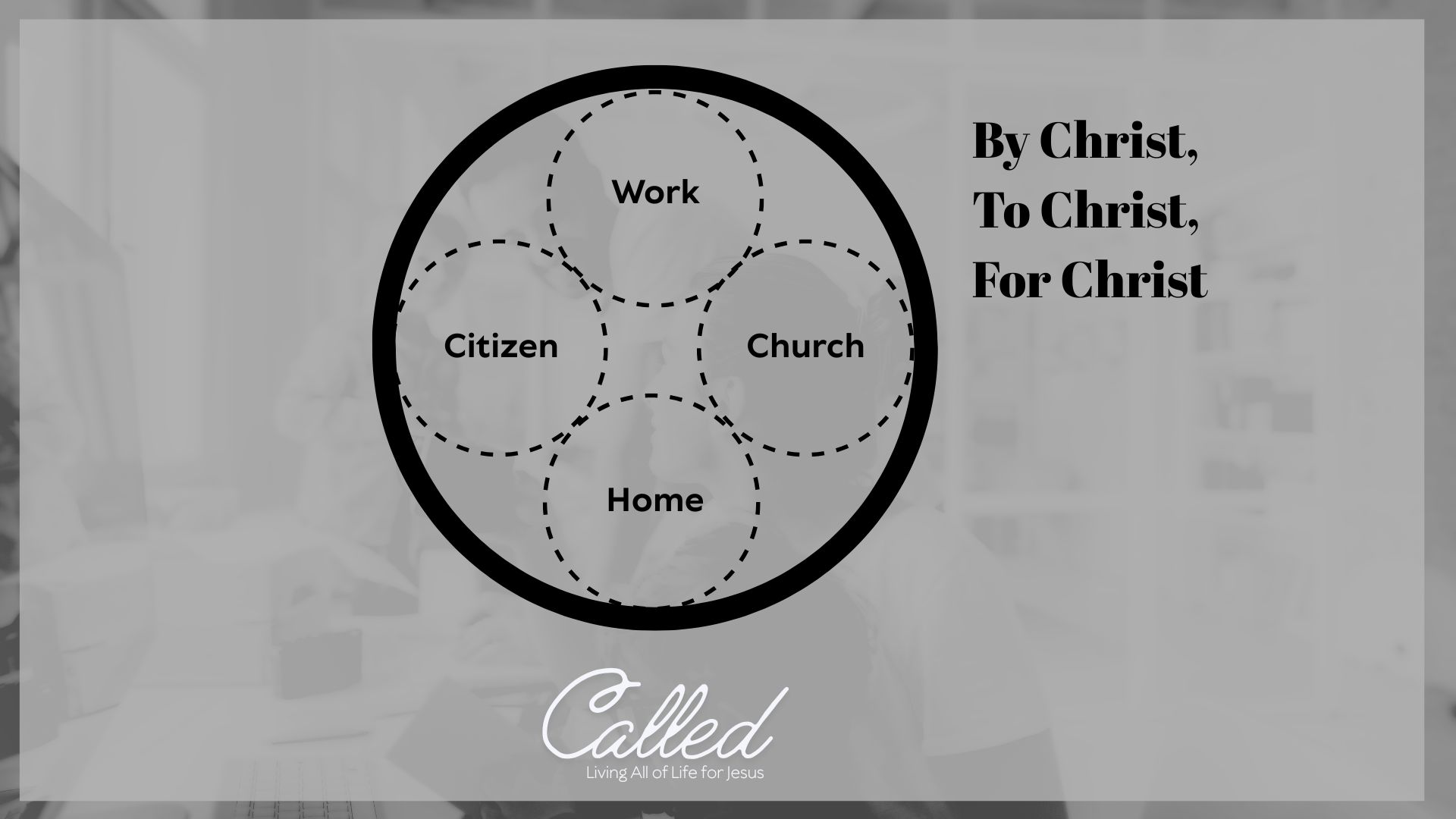
Our secondary callings matter because of our primary calling
Consider Colossians 3:22-24
22 Bondservants, obey in everything those who are your earthly masters, not by way of eye-service, as people-pleasers, but with sincerity of heart, fearing the Lord. 23 Whatever you do, work heartily, as for the Lord and not for men, 24 knowing that from the Lord you will receive the inheritance as your reward. You are serving the Lord Christ.[4]
The second thing that we need to keep in mind is that each of our secondary callings has value because of our primary calling. As one group of godly Christians wrote, our chief end is to glorify God and enjoy him forever. How do we do that? How do we live this call that God has given us to Himself and for him? It’s through the various things that he has called us to in life.
In fact, through these callings God works in the world. Martin Luther writes that when we pray the words of the Lord’s prayer, “give us this day our daily bread,” we are praying for the various callings that are involved in this request. To modernize it, we could say; We are praying for the farmer working the field. We are praying for those who are transporting the grain to the mill. For the processing, for the trip to the store. For those who stock the bread at the store and the cashiers. For a safe trip to the store. For our own paid work, it will be sufficient for the bread. God answers our prayers through all of it. Or as Luther put it more directly, “through the milkmaid, God milks his cows.”
Greg Gilbert puts it like this,
Think how freeing it is that you have multiple callings in your life, all from one Boss, who sets standard for faithfulness in all of them and gives you that standard. It’s not as if he’s given us an impossible mandate for every area of our lives—though in this fallen world it may feel that way at time. Rather, he’s given us a specific standard of faithfulness in each of our callings and then one goal for all of our callings. For example, believers are called to be church members. Christ’s standard of faithfulness as a church member is laid out in Scripture. If you’re called to be a father, Jesus’s standard is that you instruct your children in the discipline of the Lord and provide for your family. Because we know that Scripture is sufficient, you should be able to find Christ’s standard of faithfulness for every calling in your life. And, as I said, across all these callings, there is one goal: to “do all to the glory of God,” to “make the most of every opportunity because the days are evil” to quote Paul in Ephesians and Colossians. So, should you spend more time at work, or at church, or caring for your aging parents, or caring for your indigent neighbor, or signing up for a family camp with your kids? You should use immerse yourself in the Word so that you can fully understand Gods’ standard of faithfulness for each of these multiple callings and feel the urgency of your one goal: to bring him glory. And then you have tremendous liberty in Christ to trade off across these different callings in order to accomplish that goal, something you’ll do prayerfully as you seek wise counsel from others.
Getting these wrong leads to distortion
The catholic distortion
Those who assess the doctrine of work often discuss two general types of errors or distortions. They go in the opposite direction. The first is the catholic distortion. The catholic distortion is called this because it arises from within the Roman Catholic Church. It was one thing that the reformers responded to in the Reformation. Eusebius, Bishop of Caesarea, argued for two types of life. The perfect life and the permitted life. The perfect life was for those who were priests, monks, or nuns. The permitted life were other callings – maid, soldier, king.
This also led to a contrast between the contemplative life and the active life as tiers of godliness. But, while Scripture warns about the weight and responsibility of certain callings, and even says that some callings within the church, such as overseer, are a noble task, in the most important sense, all wholesome callings are equal.
Consider the account of William Wilberforce, who as a Member of Parliament led the abolition of the slave trade through the Slave Trade Act of 1807. When he was first converted at the age of 25, his first thought was to leave politics for the paid ministry. Like many, Wilberforce believed the life of the ministry to be more important than so-called secular work. Happily, John Newton—the celebrated composer of “Amazing Grace”—persuaded Wilberforce otherwise. In 1788 Wilberforce wrote in his own journal: “My walk is a public one. My business is in the world; and I must mix in the assemblies of men, or quit the post which Providence seems to have assigned me.” If Wilberforce had left politics for the pulpit, he would have “quit the post” God assigned him for the abolition of a great evil.[5]
My professor, Mike Wittmer, writes well about this,
As both the human body and the church need all the different parts pulling together, so every wholesome calling is indispensable to the whole (1 Cor. 12). A pastor may wrongly think his calling makes him superior to snowplow drivers, but in the dead of winter he can’t have church without them. A missionary may suspect she is serving God better than the ordinary members of her sending church, but she won’t stay long on the field if they don’t pay her way. Ordinary jobs are the foundation of any society. As we learned in the Great Recession, when we lose jobs, we lose communities, and when we lose communities, we lose schools, parks, and churches. We can’t have a church without normal jobs to support it.
Larry Osborne tells how a highly gifted pastor lost his job because he had an affair. Not long after, another pastor offered him a teaching position at his church, and when he explained the hire to his congregation, the pastor said, “This man is simply too gifted to waste his time selling shoes.” Ouch! Imagine how every salesclerk in his church must have felt![6]
Or Martin Luther said this,
God cannot bear to see anyone neglect the duties of his calling or station in life in order to imitate the works of the saints. If therefore a married woman were to follow Anna in this respect, leave her husband and children, her home and parents in order to go on a pilgrimage, to pray, fast and go to church, she would do nothing else but tempt God, confound the matrimonial estate with the state of widowhood, desert her own calling and do works belonging to others. This would be as much as walking on one’s ears, putting a veil over one’s feet and a boot on one’s head, and turning all things upside down. Good works should be done, and you ought to pray and fast, but you must not thereby be kept from or neglect the duties of your calling and station.[7]
The protestant distortion
But there is another distortion as well. One that may be more enticing for some. This is what has been referred to as the protestant distortion. Perhaps this distortion can be seen as elevating our paid calling to the forefront and viewing it as ultimate. It can rightly see value in secular callings but they can become disconnected from the primary call.
Os Guiness writes
“Eventually the day came when faith and calling were separated completely. The original demand that each Christian should have a calling was boiled down to the demand that each citizen should have a job.” And then work itself was made sacred. President Calvin Coolidge once declared: “The man who builds a factory builds a temple. The man who works there worships there.” And Henry Ford said: “Work is the salvation of the human race, morally, physically, socially.”
This can happen is when we see the immediate value in what we do and not in what others do or how they contribute. But the person who is researching to find a cure for that disease is often just as dependent upon others in their work. The tools they use to research are developed by others. The grant they depend on for income and their work is, again, from another. The chair they sit on, the lights, and the electricity that they need. Each is a piece of what makes it possible. Understanding our primary call and how God works through secondary calls frees us from the pride that can come from the protestant distortion. It gives dignity to every calling, not just the ones we find valuable. It also frees us from finding value merely in our paid vocation.
Gilbert puts it this way,
Few of us give a thought to calling in the biblical sense. We don’t understand why we work, though we can appreciate why we may need to work. We give little thought to what work we should do, other than what seems enjoyable to us, or something for which we might have an aptitude—and sometimes declare that because we enjoy something or are particularly good at it, we are called to it. And then when work and other duties (or callings) collide, say a difficult job and caring for a family, we don’t have frame of reference to resolve the competing imperatives. Worse, we can become defined by our jobs, not our Caller, and so when we are unemployed, underemployed, or unsuccessfully employed, we can face an existential crisis.
Thank God, there is a way forward, and it is simple. We must at all times recognize that we are not primarily called to do something or go somewhere: we are instead primarily called to someone—to our creating God.
Conclusion
What is your understanding of calling? Are you seeking to define yourself through what you do instead of receiving your identity as a gift from the one who made you and knows you. This God invites you into relationship with him. Our sin has separated us from him; it’s one reason that we seek to craft our own identities. We desire meaning and purpose, and are suppressing the only true way to have it. As Augustine put it so long ago, you have made us for yourself, and our hearts are restless until they rest in you. What we celebrate this morning is the way that God provided for us to rest in Him. God lovingly provided a way into relationship with him through Christ. Jesus willingly came to this earth to provide a way through his life, death, and resurrection. This morning, the external, outward call goes out to you, Come to Him. Turn from your sin and trust in Jesus; in Him, true meaning and purpose are found. He completed His call as redeemer so that you might be saved. Trust in Him and live.
[1] The Holy Bible: English Standard Version (Wheaton, IL: Crossway Bibles, 2016), 2 Th 2:14–15.
[2] The Holy Bible: English Standard Version (Wheaton, IL: Crossway Bibles, 2016), Ro 1:1–6.
[3] The Holy Bible: English Standard Version (Wheaton, IL: Crossway Bibles, 2016), Eph 2:8–10.
[4] The Holy Bible: English Standard Version (Wheaton, IL: Crossway Bibles, 2016), Col 3:22–24.
[5] While Os Guiness uses this account, this summary is from Greg Gilbert.
[6] Michael E. Wittmer, Becoming Worldly Saints: Can You Serve Jesus and Still Enjoy Your Life? (Grand Rapids, MI: Zondervan, 2015).
[7] Michael E. Wittmer, Becoming Worldly Saints: Can You Serve Jesus and Still Enjoy Your Life? (Grand Rapids, MI: Zondervan, 2015).

 Boonstra Babble